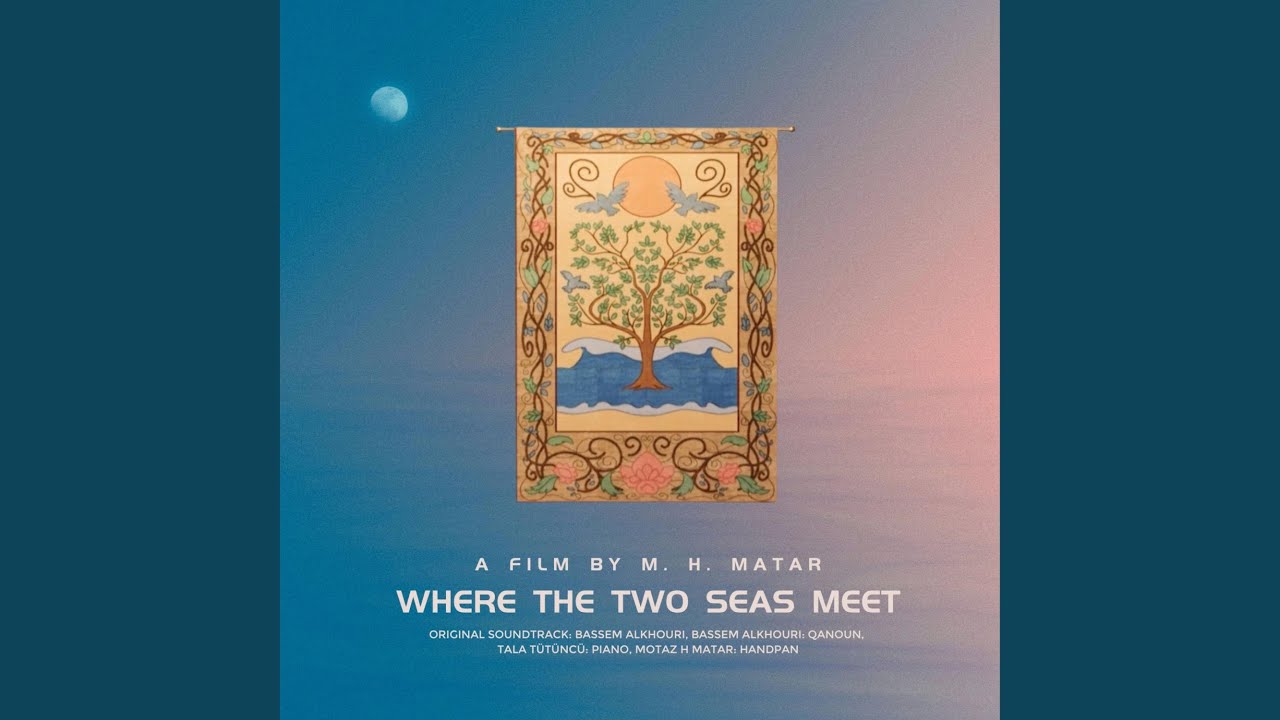
Love is 24 frames a second.
Imagine this. You walk into a small café in a town you don't know. You know nobody here. In the corner, someone is sitting. The moment you see them, you can't look away. The room goes quiet. You can smell fresh coffee in the air. You are holding a book. You look over — and they are reading the very same book.
You think you might already be falling in love. But wait. Wait until you hear the rest. Wait until you live it.
Now imagine this too. Outside these walls, the whole world disappears. Everyone you knew is gone, forgotten. You want to rush ahead, to believe everything is already perfect. But not yet. There is more story to write.
Life is a hard teacher. It shows you everything before you even get to ask your questions. Before you understand that you and this stranger have been reading the same book all along — the book of fate.
The person in the corner looks up at you. Their eyes are green, like an apple, like the very first look you ever shared. You wish your eyes were both blue instead, like an ocean you could swim in together — deep, uncertain, full of mystery.
You wish time would never run out.
A wish. Nothing more.
You wish you'd been born the same year. You wish you did the same kind of work, the same kind of art. But in the end, you're both just people — dreamers who want a life bigger than these four walls. People who want to fail more, try more, live inside the strange rain of change. Because you never really know which moments matter most. Was it a few seconds ago? Or is it now? Do you keep hoping to live that first look again?
Her name is Malak — it means "angel." His name carries its own old meaning too: "the one who owns something." What if this was always meant to happen? He forgets to pay the electric bill. He doesn't care. He's a failed writer with a few self-published books nobody's read. She's different — a mystery, a rising star in the art world. She draws pictures, then throws the sketches into the river, again and again. She never lets herself keep them. She never knows what her own hands are hiding.
He writes a poem. Blue ink, then black. His career as a writer is over, he tells himself — he hates writing screenplays now. Why does he even call himself a filmmaker anymore? He wants to hit undo, erase the whole timeline. He could make a real movie if someone handed him ten million dollars. Maybe a hundred. But is that really what he wants? He could make a different film — a better one. A film that actually means something. Forget money. Forget fame.
This is the best film he will ever make, because it is real.
Now imagine — everything you have ever lived for was only waiting for this one moment. You are the same person, really. Two halves of one thing. You already know everything you need to know about life, and about each other.
Then the conversation stops. There is nothing left to say. You ask yourself: is this a love story, or something more?
It isn't an ordinary one.
You walk out the door, step outside — and suddenly you forget everything. What happened? Was it a car accident? Did something hit your head? Or did none of it really happen at all?
You want to go back inside. The story had only just begun, but you can't remember any of it. You know nothing now. It's all gone.
Wherever you wake up next, you will have to search — search for the pieces, the frames, of every beautiful thing that made up your life. Did you forget what once made you happy? Maybe she is the one who will remind you. Remind you the way an old tape brings a memory back to life.
All of it is still inside you, buried deep. It always has been. Until the day you met her.
Now imagine: where will you wake up next?
Life moved fast after I walked out of that café door. Outside, no memories exist at all. To follow you means following the moon. To find you means following you — wherever you go.
Autumn is coming soon. The streets, the falling leaves — I would fall for you, and fall into you completely. There is a kind of madness that lives inside these frames, this beauty. Some people forget how to love. Others try to hold onto every small detail, every raindrop, the way we all fall from the same cloud into one single place.
Sometimes we arrive at the right moment. Sometimes everything comes too late.
Then, beauty appears — goosebumps, a shared glance, like a camera catching every small detail.
Light works like an old pinhole camera: it turns our memories into pictures on the wall. I wanted to write our story in pencil, something that could be erased. But I wanted ink instead — something permanent. The only way to keep a memory is to let the story dry, then collect it like a seashell. But seashells can be swept away by the waves too. You asked me once if I loved your eyes. I told you — I come from them, and I return to them. You asked if I could hold everything in one single memory, one flash, like lightning. Every kind of light means something: sunlight, moonlight, the light in your eyes, the light on a film set, the light of a good day when we can finally breathe. The light of a film we made — or did we ever really make it? To know you, I would stand again at that café door, look into your eyes once more, and turn back time.
In other words: it would kill me to lose this. I forget to breathe, to eat, to simply exist. I forget that we are our own film. Every frame is worth its weight in gold. Every frame is the deepest kind of meditation. No words are enough to describe how beautiful these frames are. All of this — we loved it even before we existed.
Back when we were children, when the world still felt perfect. How much love can a soul really hold? Let's push time forward. This is the film of our lives, even before we were born. You and I are both the director and the writer. Nobody else knows how this story will end but us. How will the pieces connect? Then — I hear something. I smell something. The beep of a heart monitor. The smell of rubbing alcohol. A hospital room, or maybe a dim, quiet hallway. A flickering light overhead.
I am born. A frame appears in my mind, a picture frame. My eyes blur, then clear again. It is time to begin. Time to find you. What's inside this frame?
Frame #1: Joy Hotel§
So many things decide the frames of our lives — things we can't control. With a single frame in mind, we can feel deep gratitude for everything around us. And yet, day to day, we ignore those beautiful things. We turn away from them.
We become greedy. Ungrateful. We always want more, even when we need less. We keep searching for healing, believing in the things we can't be sure of — the quiet magic hidden inside every single day.
Why do we always want more? Why do we chase love when love is already everything we have?
Why do we want to live forever, when we already have our frames — frames of life, frames of the sacred, frames of madness?
If I forgot it all, would I even miss it?
Everything I do is really one thing: trying to find you again. Trying to narrow it all down to a single moment — your body, your beauty. Just that.
Under the hospital pillow — silent, hidden — there is a photograph. One of the frames.
I pick it up. Nothing is wrong with me physically. No pain, no aches. I feel completely fine — only my memory feels fragile. Soft and warm, like a blanket. Like the best night's sleep I've had in a long time.
Will it be hard to find you? Will it feel like something incredible when I finally do?
I look at the photo again. As I wake up more, my eyes blur, then clear, and the picture slowly comes into focus — like fog lifting, like morning sun through a window.
Some mornings the sun rises early. Some mornings it hasn't risen yet. Once the picture is fully clear, I take a deep breath and touch it. It feels like a page from an old book.
It's a photo of a hotel room, lit with warm, cozy light, the city glowing faintly through the window. I wish I could zoom in closer, see every detail, be there myself.
There's a notebook on the desk, open to a blank page. A shadow moves near the window — a smell, a silhouette. I can't tell if it's you, or me.
I turn the photo over. On the back, in messy handwriting, someone has written:
"Find me in the reflection before the clock strikes midnight."
When the clock struck midnight, I lost all sense of time. Like someone lost and drifting, discovering a kind of freedom in time I had never noticed before.
We rush from one thing to the next, chasing one pleasure after another, never noticing that beauty is happening right now.
Every story, every script, begins the same way — with a blinking cursor on an empty page.
Not knowing what time it is — that not-knowing — is the very thing I had been searching for all along.
I could feel the time passing anyway. In my breathing. In the sunlight moving across the walls. In a distant whistle down the hall. In forgetting who I was supposed to be — my titles, my achievements — and instead just wanting, simply, to be happy. To make memories out of small, ordinary things. To exist, instead of always doing.
I've learned that I'm happiest when I'm simply a little less unhappy.
It's hard to convince myself that time itself can be beautiful — all the time, everywhere.
That if I do nothing, if some pages stay blank, that's all right too.
I can always come back and fill them later, with something worth saying. Because I love time itself.
Even a small piece of time together can feel like a drop of honey in the first cup of coffee of the day.
I've stopped trying to reach conclusions.
I hold the photograph in my hand again, the way I would hold your face, and I close my eyes.
If the morning sun can give me all the love I need right now, then I can hold onto your reflection until I reach you — before midnight.
Time feels like smoke drifting down this long hospital hallway, a tunnel leading straight to you.
A riddle, sent from me to you.
From me, to...
I get out of the hospital bed. I hope the nurse doesn't walk in to check on me — I feel fine. Better than fine.
What happens outside this one frame is still a mystery. All I know is that we belong to each other. I have to take care of this single frame, this single memory. I have to give it everything I have, and I will find you. The first words of this story began right here, in this frame.
Is the story being rewritten as I go? Or was it always meant to happen this way? If we already knew every answer, it wouldn't be exciting. The magic is in the surprise — in not knowing what's waiting at the end of the hall. Nobody knows. And talking about it out loud only weakens the magic. Nobody knows. Nobody else even cares about this story, about the words on this page. But deep down, you know — you've been writing your own fate the whole time. The world outside holds your words, your tears, your laughter, all of it. Turning away from that would be like turning away from the sun, or from the rain that feeds you — both are what keep you breathing. So — do you walk, or do you run? The world outside is waiting. Are you there? Will I reach you before midnight? I run down the hallway toward you, as if touching the last light of the sunset will carry me straight to you.
Leaving the hospital felt like leaving heartbreak behind — the kind you miss the second it's gone, even while you're walking toward something better. Lost, but strangely amused. Life, I've learned, moves like a river. When you jump in, it can heal you, carry you exactly where you're meant to go. Sometimes you flow with the current. Sometimes against it. Planning too carefully kills the joy, kills the surprise. A love worth holding onto is often the hardest to reach — we try so hard to keep it, and still it slips through our fingers. I felt good the moment I took my first step outside. Everything felt right. Maybe I could finally be who you always wanted. In the cab, I wished there had been more written on the back of that photo — though maybe that would have ruined the mystery, spoiled the dream. The cab moved slowly, unhurried. I felt urgency building inside me, even though I knew, deep down, that good things take time. Even "forever" doesn't really last forever — everything that feels infinite is actually finite. Everything that feels permanent is really just temporary. I held onto the photo, hoping to find another clue in it. What address do I give the driver, when I don't have one? After a few minutes, I noticed the glass divider between us — we couldn't have spoken even if we'd wanted to. If that cab could fly, it would have taken me straight to you. Time slipped through my hands like sand. Eventually we reached the hotel. Was this even the right place? Who could I ask, when I didn't know your name, and your face was only a small, bright memory in my mind? What would I even say to the guests in the lobby drinking their tea? I'm here to find my notebook, with words written along its edges like gold. I'm here because inside that frame is the very beginning of my life. Inside it are words that were never spoken — dreams that took real effort to make. I hope I never forget. I hope I always remember that somewhere in one of these rooms, you were waiting, and that our story would play out like an old film — real, not digital. It would ripple like water in the rain. It would carry us somewhere humanity has almost forgotten — a place to finally let go. I closed my eyes and leaned against the cab window. The next thing I knew, the cozy hotel building appeared, almost too beautiful to be real. The driver waved from the mirror, refusing my money. "Take good care of your memories with her," he said, his voice muffled through the glass. "Take care," he said again. "Your love is close to midnight." I looked at the dashboard — it read 11:50. I jumped out of the cab. Where do I go now? I searched the air for any sign, any clue that might lead me to you.
Was I late to the party? No — the party had only just started. But when I arrived, you were nowhere in sight. I must have missed you by only a minute. What is a minute, really, next to the endless joy of finding you? I asked everyone I could — the sparkling chandeliers, the long hallways of the hotel. Every door was closed, leading nowhere. But somehow I still felt lucky just to be there. Joy always comes, and so, some would say, does sorrow. In that moment, I only felt the joy. That flashing instant felt worth everything — I felt like a child chasing after life itself, untouched by daily worries, by fear, by anything complicated. I paused, holding the first photo in my hand. It wasn't just an image — it was a direction. A compass. I felt far from the noise of the world, closer instead to this single, quiet moment. I made my way to the hotel room, knowing another photo waited for me on the desk. We were playing a kind of game — collecting these frames, like angels collecting small pieces of light and sending them back down to earth. You were there for me the whole time. I saw you in each reflection, one by one.
Frame #2: Gratitude Balcony§
Why weren't you there? Couldn't you have waited just one more minute? Then I heard your voice, as if it echoed through the room: a minute has sixty seconds. That's more moments than we know how to appreciate. We forget to say thank you. We forget the small things, letting them pass by unnoticed, always wondering if what we have is ever enough.
I stepped further into the room, and it changed completely. I took a deep breath — warm water was somehow floating all around me. I wasn't afraid it would drown me. I wasn't afraid that what I felt in that moment was true. I didn't punish myself for simply existing. I found myself swimming through the room, breathing underwater like a fish, reaching for the photo the way you'd reach for life itself. The photo floated toward me. This was the second frame — and together with the first, they were beginning to form something, like two paintings hung side by side in a museum, like one heartbeat followed by the next. What did this one hold for me? Was fate something to be afraid of? I reached for the photo and hugged it close. It showed a balcony — two chairs and a small coffee table. I turned it over. The moment I read the words, all the water vanished like steam: "There's a balcony. Notice every detail, every moment. Between the two chairs and the small table — meet me there."
To go somewhere with no map. To exist inside the unknown, still trusting that I would eventually arrive where I was meant to be. Everything felt complete, even without a clear sign. You know you've been forgotten, and yet somehow you also know you were happier than ever — because you sense the next good thing is close, just behind the next door. You want the rain to come, and you want the pain to leave. You've already found the things you're grateful for, even if you don't fully realize it yet. The next move is always just a touch of a hand away — you want everything to arrive at once, but it isn't time yet. So where do I go? Out of the hotel room. I held the second photo and wandered the street like a traveler, watching people pass by, watching the slow-moving cars. I thought about the two chairs, the coffee table. There was a row of small cafés along the street, plenty to choose from, people laughing over their coffee. I kept walking, hoping for a sign, waiting for one to fall from the sky like a feather. I looked closely at the photo again, wishing it would turn into a moving picture — that the two chairs would somehow meet, like two clouds crossing paths in the sky. In the photo, the coffee table held a blurry frame, a deck of cards, and a single cup of coffee.
I asked the waitress for a black coffee just like the one in the photo. She laughed and said she'd try. She disappeared inside and came back what felt like hours later. She found the coffee, she said, but never found a notebook on any table. "We have our own notebooks, if you'd like to see them," she offered. I told her it was fine — I just wanted my coffee. "Now, or later this afternoon?" she asked. Did it matter? "It matters more than you'd think," she said. "A single cup of coffee can be the difference between missing the sunset and truly seeing it — appreciating every part of it." She smiled and went back inside. The sky slowly changed color, the whole city seemed to slow down, and I was filled with a feeling I couldn't quite name.
The waitress returned with the coffee. "You'll need to hold this one yourself," she said. "I can't set it down — it might float away." The best things in life are the things we learn to appreciate. Don't take them for granted, or they might slip right through your hands — spill on your clothes, cloud your whole picture. I took the cup gently from her, and with my first sip, the sky turned a bright, glowing orange. It was the best coffee I had ever tasted. "Meet you there?" I thought.
I sat with my legs resting on the edge of the balcony. A faint shadow fell across the wall, and there on the table was a deck of cards. That afternoon, so many questions filled my mind. I didn't want to waste time, and yet I didn't mind wasting it either. A few perfect moments blended together with the images on the cards — one with missing eyes, another with the second cup of coffee, and a third card, completely blank, its edges lined in gold like feathers. It felt like a joker card — something you could shape into anything you wanted. Like gratitude itself: a choice not to suffer, a choice to accept that some moments are already complete, even when they don't feel that way. Some things seem unimportant only because we never really pay attention — we're too busy filling our days with small, dull distractions. What is the greatest gift of all? Simply to exist. To be present in the moment. To quiet all the noise.
That third card stayed blank and mysterious. If only I could slide open the balcony door, if only I knew whether the second coffee cup was really missing. Maybe it was in the kitchen sink. Maybe it was in the bedroom. But some answers only become clear once you look back. You can't connect the dots until you've seen the whole film — you never know how a sunset will unfold, whether these lips will ever kiss. You never really know — but this evening was a pure, quiet kind of magic. What is gratitude? It is time itself — time to slow down, to be thankful, like some forgotten, quiet corner of the universe. The last light of the sunset landed on the small table, on one of the cards — and then the rain began. The blank card transformed into an image of a street lamp and an umbrella, with words written on the back: "Let's take the bus to the next station." When it rains, it can still turn into something wonderful. The rain fell on my head, and its drops led me straight to the bus station.
Frame #3: Serene Rain§
The rain fell hard on the umbrella, loud as thunder. I opened my hands to the sky, letting the rain fall into them. I wore a raincoat. Everyone else at the bus stop had umbrellas too, as if they had all planned this trip in advance. I had no plan at all — I had simply ended up at the bus station, hoping the rain wouldn't stop, hoping the bus would carry me to wherever I was meant to go next. The rain kept falling that night, full of energy, making every feeling feel true. Did the rain change that blank card — or did the card make the rain fall?
Did love change us, or did that first meeting become love all on its own? I hoped things would be different this time, even though wishing rarely changes anything, and the rain falls no matter what. When the bus arrived, I climbed on and sat alone in the back. Nobody else was on board except the driver. I watched the city pass by the window and wondered if the driver somehow knew about us, the way the cab driver had earlier. If he knew, maybe that meant we really were meant to be.
Maybe he'd heard some rumor — that when the rain falls like this, it can take ages before two people find each other again. Something felt uncertain, some worry that we hadn't truly met yet, that with every dream I drifted further from you. I wasn't sure how to feel — a little troubled, then suddenly calm again, certain we belonged together, that you were made for me. My mind settled into something like meditation. I watched for the next stop, sure that even a single drop of rain could break apart everything we thought we knew about life. One drop became a thousand on my head. You still wouldn't let the rain touch your hair, hiding under your umbrella — were you even there? The windshield wipers moved faster, and so did my thoughts — like a writer chasing an idea, working backward through the plot, changing the angle of the whole story. The bus seemed to speed up. If the rain ever stopped, would you finally show me the way to you? Then it hit me — even apart, we were still together. Even in silence, we still belonged to each other. The bus sped on, leaving the city behind. Looking out my window, I saw we were heading straight for a bridge. The bus should have stopped — it didn't. It went faster, toward the edge, toward the cliff. The driver turned and waved goodbye. Where was this bus even going? We were flying. I was flying. Everything spun, and I found myself falling into the ocean below. A picture frame flew past me — I caught it like a feather in the wind. The thrill of waiting isn't over until you finally reach the water, until you let yourself fall in, wondering. The frame itself held a picture of a vast, deep blue ocean. And I was falling straight into it.
Frame #4: Ocean of Wonder§
Who is it that wonders, really? The ocean waves moved like a shiver across my skin — cold, but somehow as gentle as your touch. Like meeting someone when you're both a little afraid. The waves pushed me back onto the sand, and I held onto the frame the way I held onto every memory of wonder, of joy. The waves carried a kind of mystery — a feeling of being completely whole, rocking me like a cradle, even though these moments never lasted long. I thought I might see something beautiful hiding in the water. There were no frames here anymore — just something enormous, wide open, with no real edges, revealing more and more the longer I looked.
It was quiet and peaceful. I thought the horizon went on forever, though for an adult the horizon always seems to shrink a little more each year — the same way every love story eventually drifts into uncertainty, wonder slowly fading away. Useless assumptions, all of them. This ocean of wonder felt like something you had shaped yourself, with just the touch of a fingertip — turning something small into an entire universe of water. It belongs to you. Your wonder, forever.
We stay like children at heart — no responsibility, no matter if this is a short story or a poem, mystery is simply part of who we are. Anyone who saw me alone by the ocean might think I'd lost my mind. What was I even waiting for? They'd never understand that wonder is a dreamer's secret weapon — a writer's best tool for managing time and possibility, even when time itself moves slowly. The waves stayed calm. I wasn't going anywhere. I waited for a sign from you. No guilt in waiting. No guilt in doing nothing at all. No regrets. You were a single drop inside this ocean, and I fell into you completely, like a novelist finally discovering the love story of his life. In that story, there is only wonder. What if we could fit an entire life into just a few perfect frames, a few perfect memories? There's something bigger calling to us. The sun hadn't risen yet, so I walked along the beach for what felt like forever, kicking sand wherever I pleased. Then I felt a sudden urge to run — though toward nothing, no destination at all. I ran barefoot, back and forth, drawing straight lines in the sand, wondering if those lines would ever meet, like the lines on our two palms. That, too, felt like a kind of wonder — like the very last line in the notebook.
Did this mean the story was ending, or just beginning? Running felt like another way of waiting — we always run toward something. But I wasn't running from anything, or toward anything either. It simply felt like the right thing to do — like turning the pages of a book, of a story. There was no music, only the sound of the waves. Was that sound somehow guiding me somewhere? I kept running until my feet grew tired, kicking the sand harder, never running out of wonder. I noticed I'd carved a street into the sand, a road. I stopped. The sound of the waves faded into the distant sound of traffic. I turned and saw faint lights ahead. I walked toward them and, for the first time, saw the moon reflected where the sand met the pavement — a beautiful, strange sight. There was a street nearby — did I remember it? Its thrill would stay with me. I looked down at the moon's reflection in the ground and wondered how it carried that light so perfectly. In wonder, I held onto the memory. When I looked again, the frame had appeared, printed on a single leaf from a tree.
Frame #5: Thrill§
Picking up that leaf turned everything into autumn. The street changed too — a cool breeze, dim streetlights, no cars anywhere, as if the pavement itself had become one long autumn road. Something was missing — the thrill of holding someone's hand. I walked forward, drawn like a light at the end of a tunnel, imagining you watching from somewhere far above, like a star in the evening sky. Every time we step into the unknown, everything becomes a little more beautiful. My whole body felt the thrill of simply walking. Why did walking feel this exciting? I wasn't even running. There was no rush of adrenaline. I walked toward music, toward flashing lights, like a bird finally flying toward the sky, like someone regaining their hearing after years of silence. What made it all feel so thrilling — the sound, the sense of belonging, the dreaming?
Along the road stood a bar. No guard at the door, no cars parked outside. A soft maroon door opened like a theater curtain. The music pulled me inside — people sitting around, talking, dancing, some in pairs, some alone. They danced for hours. I felt lightheaded, lost in time — the place felt like both a theater and a bar, part of life's strange performance.
I ordered a drink. The bartender handed me something calm and bittersweet, like rain. It seemed to reach straight into my soul. I felt the urge to write everything down — because a thrill like this is fragile, so short-lived that I wanted to capture it on the walls themselves, like a child's mural stretching far beyond what anyone could imagine. "Write," the bartender told me. "Write this moment down, in pencil. Write it like it's meant to last forever." I scribbled quickly, then slower, small letters spilling out everywhere — on the bar, even on my own hands — hoping for some sign from you, hoping to feel this same thrill again, fragile as it was, the perfect cure for worry and busyness.
The bartender looked at me and smiled — my excitement seemed to make her smile too. I closed my eyes and danced, the music growing louder, every sense alive. When I opened my eyes again, the music had stopped. A phone rang — an old rotary phone. Who could be calling me?
The dancers had vanished. The music had gone silent, but the phone kept ringing. It hung on a wall between the bar and the restroom. I walked toward it as if walking toward something sacred. A soft voice — it was you. You said only one thing, then hung up: "Go from thrill to right now." The sky outside felt calm. "Take every memory, and rewind it — right now." Then the line went dead. Beside the phone was a photograph — the same red phone, sitting next to a bed. I touched the photo, and your voice, singing the last word, echoed in my mind.
Mountain§
Beside that phone, lying on a bed, I felt more content than I ever had. It wasn't really a bed — it was soft earth on the side of a mountain. There was no real phone, only its picture beside me, as comforting as a pillow, as if you somehow knew I was lying next to you. It felt like a dream come true — high above the world, more at peace than I'd ever been. Everything beneath the clouds drifted quickly by, and I felt my body float. I reached out to touch a cloud, tried to reshape it with my hand. The clouds shifted every time I blinked, every time you winked from somewhere far above. Every sound faded, and I felt myself drifting, sleepy, as though wrapped in something soft. I wanted to breathe in the air itself, wherever it carried us next — resting my head on your lap, your chest, maybe even a notebook full of words like birds in flight, on old rooftops, or inside a Roman theater. We could have gone anywhere. The sun wouldn't have burned you — maybe the story would have, but there was no story yet, no path laid out. We could have gone anywhere at all.
I turned onto my side, my head aching, as if I hadn't slept enough. "We should rest a little more," you said. I refused — I wanted to stay awake until the clouds gathered above us, like a flock of birds. Even without them, I still had you close. One of the clouds turned into a hand, and that hand pushed me right off the mountain, sending me tumbling down like a ball.
I wasn't scared. I'd sleep later, I told myself. I rolled faster and faster, until I finally landed with a letter clutched in my hand: "Right now is exactly where you are. Look ahead — an amusement park. Can you enjoy the ride? Can you laugh?"
Frame #6: Children's play & ride§
Are you still a child somewhere inside? Or just as tired of being an adult as I am? Every game we used to play has turned into something heavier — a responsibility, a worry. I didn't want to play that kind of game anymore. I only wanted to feel innocent again. Your invitation had come at exactly the right time. The whole point of life is to enjoy it — there's still so much left to write, so much left to laugh about. We're all tired. We want more of everything, even when what we already have — each other — is enough. Tickle me until I laugh, maybe I'll wake up from this dream — though I never really want to. Let's change the game we're playing. Let's make it about the best childhood memory, about the simplest, truest intention: to stay like children, and to play. Take this ride, and don't question the hidden things inside you that few people understand — why you do what you do, why you refuse to grow up completely. That child with the good heart — smile, because every time you do, something like an angel is born. Climb the stairs quickly. Run.
There are about a thousand steps to the top. The faster you climb, the freer you'll feel, because laughter is waiting at the very end. If you don't climb, you'll stay trapped — a prisoner of your own making. You could be free instead. Come with me. Take my hand, and let's laugh together. Who cares what the rest of the world thinks, wasting time on grown-up worries? Climb now — this is the door to childhood, calling. An old tape, worn and grainy, that will never play again unless you reach for it. The laughter still echoes here. If you make it up the stairs, you'll earn a ticket to the ride, and you'll find me waiting close by. Something of me. Everything of me. You'll hear my laughter.
I ran up the stairs, past jasmine flowers, breathing in the fresh air. Near the top, I found a bicycle, with a note attached: "You are as free as a bird. Ride your bicycle..."
Frame #7: Freedom Road§
This is what freedom feels like — riding a bicycle, even stumbling, even falling sometimes. The wind on my forehead, the morning sun warm on my shoulders. I felt happy, free, like a child again — like a bird finally let out of its cage. Suddenly, everything clicked into place: the waiting was free, simply being was free, beginning was free, even pedaling was free. This was where the search for you truly began — like traveling backward toward childhood, everything finally ringing true. I knew I wouldn't see you again for a while. This was part of the film we were making together, part of the larger journey. Where were we headed? The wind pushed against my face as I pedaled faster and faster, until the motion of my legs seemed to carry an unstoppable power. I couldn't even see my own feet moving — the road beneath me seemed to unroll like sheets of paper, disappearing behind me like magic. I kept moving, catching whatever road remained ahead.
It didn't matter what kind of road it was — the whole point was simply the ride itself. Even if the bicycle felt as light as a feather, even if its wheels seemed to spin forever. At the very edge of the road stood a library, with a long stretch of steps leading up to it, and a mailbox with the words "Freedom Road" printed on the side: inside, it promised, you would find real beauty. Real poetry. A book made of the everyday, and of the extraordinary too.
Frame #8: Library of Sublimity§
What kind of library was this? I was ready to step inside, into this place of great beauty. The moment the door opened, light poured over me, warm against my back, like your touch. Inside, countless books lined the shelves in perfect order, each one standing proudly, holding its own words. The library itself was completely empty — just me and my own shadow. Just me, and this narrow, endless moment, my eyes wandering sideways across the shelves. I felt calm, then a sudden, sharp headache. I walked between the shelves, into the mystery section. I reached out and touched the air, and slowly, thoughts began returning to me.
I walked to a table and found a book lying face-down. Should I turn it over? Could it hold something meant just for me — for you — from somewhere beyond us both? I opened to the first page. A photo was taped there, and it was the very last moment I remembered seeing you, outside the café. Who had taken this picture? I saw myself, walking out of that café door. I turned to the next page, and there were all the frames I had collected so far. What did it mean?
I know this all feels confusing. I hope this brings you a little closer to remembering — this notebook, this frame, my love. In life, we're always searching for something to hold onto, something to belong to. I'm trying to bring you home. All you can remember right now is the last thing you remember. I'm not running from you — I'm bringing you back to yourself, helping you see, helping you remember. That last moment outside the café is what you'll keep coming back to as you replay each frame. You'll remember why you're here, and what all of this has been for: the memory itself. The memory isn't lost. It's simply waiting to be lived again. A car accident scattered it, but with love, I will bring you home. Don't give up on this journey. Come home. I'll wait for you.
PART TWO§
OUR STORY§
Frame #9: Hope Garden§
This part of the story is about hope. Every story begins with a single frame, like a window opening onto the world. Slowly, that window narrows, showing us the things we once overlooked, the things we skipped past. The library had led us here — it didn't matter what the books said, only that their pages led like a summer rain to this bench, covered in small cards, sitting in a garden. Did you leave this here for me? Did you say "home"? The memory was slowly coming back. Memory is a path that sometimes needs correcting — a wide, quiet garden filled with berry trees spreading across the ground like a carpet. Some say never to step into a garden like this one. We say our garden is simply a moment of hope. Can I sit here and write? I haven't had enough silence, away from the world. I hope that we are close. A warm kind of sadness — we've always loved that feeling.
Hope doesn't rush. Hope lets our frames develop one second at a time. Hope is patience, waiting for the whole picture to come into focus. Could you press a button and hand me my memory back? Did you leave just one frame here, or the whole story? You wrote to me frame by frame, and together we're writing the whole thing. Hope smells like your cologne, like your suit, like my red dress. Hope is knowing that every time you come closer, it feels better than the last. Your memory will still feel unclear — write down your words, and step inside the house. Once you cross that threshold, it will finally feel like home.
Frame #10: Family love§
Step into our home — we were here once before. Within seconds, the memories start coming back, crawling, almost pleading to be remembered. Your spot on the couch. Your things. Cigarettes. Notebooks in every color. You'll realize you've been writing here, and rewriting. You've been here before — remember? Watching television. We made love here, remember that too? Hearing your voice again, from the very first step inside, and then the taste of our lips returning slowly. Vanilla, or your favorite berry flavor? No — chocolate, your favorite. You asked me for it once. It felt like everything had finally arrived, like something that had been quietly cooking all along.
I sat on the couch and closed my eyes. I took a deep breath. Still nothing — none of what you'd described came back to me. I decided to walk through the house instead, exploring each room like someone seeing it for the very first time. I walked upstairs, my hand brushing the staircase, the walls. Someone had clearly been living here. It was silent. The smell in the air felt strangely familiar. I stepped into a bedroom. A jacket lay across the bed. I picked it up — it smelled of cigarettes and grass. Picture frames sat by the bedside, empty, without any photos inside. What had happened to the photos? In the office, a computer sat with a large screen. I tried turning it on — nothing happened. A screensaver played on a loop: an old red Mercedes, E-Class. Every so often, a few words flashed across the screen before returning to the image of the car — a place you had once taken me, where our hands belonged together, where you had waited for me. The car keys sat right beside the keyboard. I looked out the window, and there it was — the same red Mercedes, parked outside.
Frame #11: Melancholic road§
I took the keys to the Mercedes. When I opened the door, I smelled the old leather seats, saw the classic steering wheel. The whole cabin felt like it belonged to another time. I gripped the wheel and drove away from the house, a wave of sadness washing over me — it had started to rain, and the wipers moved as if they already knew. I drove and drove, down a long, straight road. No familiar faces. No buildings. Nothing. Just me, this old Mercedes, and a quarter tank of gas. What had happened to the world? Where had it all gone? It felt as if everything else had been erased, and somehow that made every remaining moment more beautiful. Every moment now felt bittersweet. I kept driving, waiting for more of the story to reveal itself. Everything familiar had turned unfamiliar — moving forward felt strangely like moving backward. Every step forward brought a little more happiness. Every mile felt like a quiet reward. Too much thinking, and not everything stays afloat. The car couldn't drive forever — eventually it would run out of gas, and everything would stop. Where would it stop? Maybe it really was meant to go on forever. What goes on forever? Happiness, maybe?
Do we really grow happier over time? Maybe what we actually need is a little more of this quiet sadness — humbling, grounding, strangely beautiful. My hand rested in yours over the gearbox. Everything else in modern life runs on autopilot, but this — this wasn't something we wanted automatic. We wanted more chances to meet each other, more room for spontaneous love. A flickering image appeared in the empty seat beside me — a feeling of belonging. I noticed a radio, an old cassette tape. I pushed it in and turned up the volume — our favorite song played, and I could almost hear your voice, your hair blowing through the open window. That flickering image looked back at me: this is what belonging feels like. Where do we truly belong? To each other. The car came to a stop in front of a park. Was this the place we belonged?
Frame #12: Familiar spaces§
All I wanted now was somewhere familiar. Tired from the whole journey, I noticed a place that caught my attention — a swing, moving gently in the wind, and a small playground. It felt like an early morning, the kind where you sit for hours on the edge of a swing with nowhere to be. No work. No responsibilities. Maybe just a quiet rest, and the soft ticking of the watch on my wrist. I understood, in that moment, that this particular time — right now, as it was — would never come back again. Never again. If I could write a letter to my younger self, to you, what would I even say? What if I got to choose which frames to keep, which ones to let go? I closed my eyes, like a painter caught in a sudden vision, clocks melting all around me — time itself seemed to soften. There was no regret here. No looking back. No sense of failure or success.
In my mind, I saw flashes of memory, burning images of love and longing. I saw the future, faint and murmuring. The swing slowed to a stop. I opened my eyes. Everything came into focus. This place felt familiar — safe, filled with things that reminded me of you. I looked up and saw a passing cloud, and there you were, waving from a nearby rooftop. A small mirror caught the light and reflected it straight into my eyes, blinding me for just a second — and somehow, it set me free. Now it was my turn to decide how the story went. I became the one writing it, directing it. I became the memory itself. Strong, for both of us, for good. I ran from the park toward the building, every step reminding me of you, of us, of the way the birds used to fly overhead at the peak of the day.
Frame #13: Rooftop Wave§
The rooftop seemed to wave at me, calm as the surface of a still pool. My memory was slowly returning, piece by piece, even if I still didn't fully understand how. I rushed toward the building and up the stairs. Every step felt like an embrace. I could hear your voice, smell your scent. I pushed open the rooftop door, and birds scattered into the air around me. I saw you sitting on the edge of the roof, legs swinging over the side, the way birds move their wings, the way feet move through water. Was it really you? I sat beside you and rested my head on your shoulder, the way you'd rest your head on a soft pillow. Everything in that moment felt calm — even the birds seemed happy to see me. The moment itself felt like becoming a memory. Everything had finally come full circle. I looked down and found a plane ticket in my hand. I turned to you, but you were gone. I looked out over the edge of the roof, and I wanted to fly. "Fly?" you asked. "Yes — let's fly, together." This is where we would finally meet, finally find each other. Our life together was starting now. "Meet me at the airport gate," you said. "Let's make a memory. Let's make life itself a beautiful one. There's no point in regret. Take the ticket, and come find me. You can create the memory — or maybe I will. Don't wait around for me to guide you. I'll be waiting for you to draw every frame, until we finally meet again, in each other's arms." I picked up the ticket and headed for the airport, like a bird finally taking flight.
Frame #14: Optimism gate§
Every story starts at some kind of gate — a place of hellos and goodbyes, of beginnings and endings. I waited at the airport gate as flights and passenger names were called out, one after another, cities from all over the world. I sat there, unsure of where I was even going, unsure when the gate would finally open, when it would let me through. I told myself: it's time to take the first step toward making a real memory. Where do I even begin? When does the soul really start? The city where I'd been born was never called. My flight number didn't exist on the board. An exit sign glowed nearby. After what felt like an hour, I looked up, and every other passenger had already gone. I was completely alone in the airport. Every plane had left, and I had only one choice left — to push the gate open myself, and accept whatever waited for me on the other side. Whatever it was, I would embrace it, wherever you were, I would find you. I looked around again — even the security guards had vanished. It was time. Time to push the gate open, time to finally see, to feel, to truly live — to move toward a life built on love, a life with the fewest regrets possible. Stop overthinking what might happen. Let love surprise you. Let life reward you. Leave the comfort of the past behind, and step forward: I'm coming to you.
Push open the gate of your dreams. Push open the gate of creativity. Everything we had ever done was really about being together, about being different from everyone else. Our souls were rich with it. Everything we'd done was so that one day, we could wake up knowing we had truly lived — and by the way, once you open this gate, you'll find your notebook waiting again. It holds clues, your dreams, your scribbled notes — and they'll lead you straight back to me. Do you remember the date of the exhibition? Once you finally travel, you'll be there with me, right? And then I'll come home with you — piece by piece, our whole story hung on the walls of a museum. I'll give you the date. I pushed the gate open. Sunlight poured over me, almost like heaven itself. I was traveling — and traveling, and traveling.
Frame #15: Radiance bedroom§
It was a beautiful hotel bedroom overlooking the beach. I woke up alone — but somehow I didn't feel alone at all. I woke to the scent of perfume, and my first thought was: if I finally find you, does that mean the story ends? That all the mystery, all the searching, would finally be over — the way we chase happiness every day, and once we find it, we assume the journey stops. But there's nothing left to search for once happiness arrives, is there? No — that's not quite right. Once I find happiness, the real story is only beginning. There's still so much more to discover, together with you. I want to spend my whole life with you. Let your perfume fill the room, pour over everything. The rest of the world wouldn't understand us, and honestly, it doesn't matter. Bring your love, pure as sunlight, and let it fall over the start of a new day. Love isn't an ending — it's a continuation of everything that came before it. It's something that keeps radiating outward, endlessly. It was time to get out of bed. Something caught my eye — the ocean waves dancing in the sunlight, and there you were, dancing along the beach, dancing forever.
Frame #16: Dizzying happiness§
At this point in the story, it felt frightening to slide open the bedroom door, to step outside toward the beach, to finally meet you. Don't hesitate. Don't even blink — because if you do, you might miss your one chance at real love, at living inside the world you were meant to create for yourself. I tried to pull the glass door open, but it was locked, and there was no other way out of the room. I watched you, hoping you would turn and come open the door yourself. You stopped dancing. Your hair moved like something out of a fairy tale, and slowly your whole figure turned into a silhouette that took my breath away. I called your name, but it was like shouting into empty space — you would never hear me over the sound of the waves. It felt impossible, and still I fell completely in love with this image of you. Wait — was it even a real image? A painting, maybe. The scene outside my window froze completely — a red dress, an umbrella. It wasn't raining, though it looked like it might start any moment. The door itself had become a picture frame. I felt myself step outside my own body, watching myself stand there, looking out at the hotel room. This, I realized, is what happiness actually feels like — stepping outside yourself for a moment, and finally seeing the whole picture clearly. Trust that everything will be okay. Trust that imagination is the most powerful force we have. The creativity inside both of us — let's give in to it completely.
Frame #17: Creative Imagination§
After that overwhelming happiness, where do you even find yourself next? I knew I had to leave the hotel room, to run outside. Did I mention that in that moment, I felt something creative stir inside me? The whole scene had frozen — there seemed to be no way out of that hotel room. If I jumped through the glass, what would happen? The only way forward was straight through it. Before you could walk away from the beach — if you could even hear me — would you believe that I was only a few inches away from you? I realized there was only one way through: to imagine differently. To imagine the glass as something other than glass. To imagine the whole beach as a painting, something drawn by your own hand, something we had created together simply by dreaming it into being. It was time to leap into you, to merge completely with the picture. You turned toward me and said something I couldn't quite hear — if only I could leap straight into you.
Frame #18: Creative Imagination§
Some stories end exactly where they began. The moment I jumped, my whole body merged into the picture frame. Suddenly I was back in the same hospital room where everything had started — standing by the door, looking in. You were lying on the bed, your eyes half-open. Had our roles reversed? You pointed at me, gesturing with one finger, calling me closer. I walked toward you. The room felt familiar — the same smell, the same feeling, as if I'd never really left. I walked to your side, struck by how peaceful you looked, and I heard you whisper. Your voice seemed to echo through every part of me.
"It's time," you said.
"Time for what?"
"It's time. I'm having a baby."
"A baby?" Your tears began to fall. Were they tears of joy, or something else?
"It's time — but I can't have the baby yet, because the story isn't finished."
"What do you mean, it's not finished?"
"It's only finished when it's finished."
"What does that mean?"
"You'll understand eventually. We still have a whole honeymoon left to live. We have to decide how it begins. We could choose for it to never really end — the way we met outside that café for the first time, before we ever lost each other. This happens to everyone searching for a place to belong, everyone searching for meaning and happiness. The road might twist along the way. Getting lost is part of the journey. Now — look into my eyes."
"What do you see?"
"I see memory."
"What memory?"
"The one we lived together."
"All of it?"
"Don't let my tears fall any longer. Please, go now. If you stay, I'll only cry more. Between us now is only the smallest distance — the blink of an eye."
"Don't give up before the story is finished."
"Whose story is this — yours, or mine?"
"It begins with you, and continues with me. It ends with both of us together."
"The only way to finish it is for you to leave, right now."
"Where do I go?"
"I'll give you the address, the street name. You just need to be there, on time."
"Are you sure this place even has an address?"
"Yes. Trust me."
"Didn't a fortune-teller once say that the person you love has no fixed address, no fixed place?"
"This is more real than that. More real than ever."
"Close your eyes, and you'll be with me."
PART 3: REPAIR§
Frame #19: Vibrant museum§
I knew you said you'd be there, but you hadn't arrived yet. There were guests everywhere. I walked through the crowd like a ghost — if I spoke to anyone, they wouldn't hear me. If I nudged someone, my hand would pass right through. I knew you'd said you would be there. Instead, I saw you in the paintings hanging on the museum walls — eighteen of them. Every frame we had lived through, every emotion, each one telling its own small story. It felt rare, almost sacred, to see moments of a whole life displayed for the world to see. Each one meant something. I walked past every single one, and my heart felt completely full. I wished you were there to see it with me. They were beautiful — so beautiful. Then I remembered what you'd told me: finish the story.
When I reached the twentieth frame, it was simply an empty canvas. Was I supposed to fill it in myself? To paint it? The whole room went quiet, and every guest turned toward a small podium with a microphone. Your voice echoed through the room. I looked at the empty frame again, then back at you. It was your turn to speak. An empty frame — waiting for you?
Frame #20: Silent remembrance§
Remembrance was the theme of the exhibition that night.
"Thank you all for coming. I find myself without words, in a way — almost trapped by the size of this experience. How do you explain love to someone who has never truly lived it, never felt it through both suffering and disbelief? Every emotion I've ever felt is somewhere in these frames. They are beautiful to me, and I hope you can see that beauty too. Each one is a kind of dedication — a real one. In life, these moments moved me deeply, and they still do. I decided to end the collection with an empty canvas, because silence was the only way I could truly express what came next. Silence means we still get to choose where the story goes — it doesn't mean the story is over. Silence, right now, means I want to live fully in the present, to relive every memory, every single one. I believe there's still more to this story."
The speech ended. You looked at me and said quietly, "Thank you for coming."
Frame #21: Inspiration Notebook§
Welcome back home. Everything felt the same, yet somehow a little different. Was this really our life? I lay down on the couch, and beside it sat a notebook filled with my notes, my scribbles. The ink still looked fresh, as if I'd only just finished writing. On the very first page, I had written: "Love is 24 frames a second." I kept reading, page after page, losing all track of time. If love really moves at 24 frames a second, does that add up to just one second total? Somehow that question made me want to ask more, to begin again, even without knowing all the answers. What made me want to write this story in the first place? What made me want to live it again and again? It was your voice, calling from the kitchen, and the smell of coffee brewing. You walked into the room with your usual grace, your steady steps. "You know," you said, "some people think we're wasting our time making art, wasting our time simply being art, simply loving. Some people think we could be doing something more useful. But is life really worth living without risk, without love? Is it worth it?" We each make our own choice. We decide, moment by moment, who we want to be. "You can read this story forward or backward — it won't really matter. What matters is that every piece of the story is there." "So what's the recipe?" I asked.
Frame #22: Curious nature§
The recipe is simple: stay curious. Live every day like it's the very first one. Begin, again and again. The recipe means fully embracing creation — making something out of nothing. Staying hopeful. Living, and actually trying to be happy, not just pretending. Know that happiness finds you the moment you start creating. Don't chase the outcome — not now, not ever. The outcome was never what made you happy. Simply being here does. That's how we'll keep loving each other, forever. "Thank you for coming to my exhibition."
"Did I really have a choice?" I asked.
"You could have chosen not to step into that café. You could have chosen not to love me. But the fact that we found each other again means we were always meant to. Don't forget the vows."
"The vows?"
"The vows, at the very last page of the notebook."
I picked up the notebook and turned to the final page.
Frame #23: Love vows§
What are these vows, really? What makes them feel alive? Are they made of words, or pictures? Could you capture a vow inside a single frame? That's really the whole story, the whole script. If I had the chance to live it all over again, I wouldn't change a single thing. We are here, together, right now. Only this moment — no past, no future. If I hold your hand and we both close our eyes, do we see the same thing? Do we see our life the way we always imagined it? The power to bring back every single detail we've lived, to hold onto all of it completely.
In my mind, our whole life together played like a film, like a dream. How long does a dream really last — a second, or something more?
Frame #24: Bliss movie§
I opened my eyes, let go of your hand, and ran upstairs. There was a computer — I recognized it right away. I moved the mouse, typed in the password. I glanced over my shoulder. You were there. The editing program was open, the timeline ready, waiting for us to hit play. I looked at you. "Shall we?"
You nodded. I felt your breath against my neck. I pressed play. Our most beautiful moments began to move across the screen — our love, playing out like a film, twenty-four frames every second. It moved so fast. And somehow, it would keep moving — forever.
Later that evening, I found myself lying in bed. I think I'd watched the film a hundred times over by then. Beside me on the bed, I found a piece of paper — a poem I had written. I couldn't remember exactly when I'd written it, only that it captured exactly how I felt. My eyes filled with tears as I read it again and again.
I fell in love with a thousand people once,\ but you're the only one I ever truly loved.
I fell in love with life itself,\ and you're the one who taught me how to love it.
Every time I blink, I think of you.\ I think of you breathing life back into me.
Your breath — how precious it is.\ How could I live without it?
You were made for me.\ You are the light of my life,\ the ocean inside my imagination.
I fell in love with your voice,\ a lifeline reaching toward me,\ a rescue from everything dark.
You gave me life again.\ You made me myself again —
the child, the dreamer, the writer.\ If we only had a single moment,\ it would still be worth it.
If we only had a single second, it would be worth it.\ If we only had a single frame, a single word,\ it would still be worth it.
Some things never really end.\ They live on, forever.
In my memory,\ the story of our frames plays on and on.\ It becomes something more — a kind of faith.
It is a deep dive into the ocean.\ You are my wildness, my inspiration.\ You are the ocean's own dizziness.
That dizziness —\ I fell in love with it completely.
You are the best things in life:\ things the rest of the world will never fully understand.
A written word.\ A morning sunrise.\ The sound of your voice.\ Tears of joy.\ Love, too full for words.\ Running toward the sunset.\ Morning coffee.\ Traveling, together.
You move fast, like an open highway,\ and slow and steady, all at once —\ the perfect balance of everything.
You are everything I am not.\ Life with you is a single frame —\ but which one?\ It's the film we made, and somehow never made.\ Life with you is every single frame, lived forever.
I finished reading the poem, and then I heard movement somewhere in the house. I looked up. Everything had gone quiet again. Had you left, once more? I knew you would come back. Maybe you'd gone to the store, or to the airport. The door would open again, one day — and it would be you.
September 20th, 2025, 8:06 — first draft.
Edited September 23rd, 2025, 3:17 pm — second draft (last part added).
 , where you can read my work in progress. I love to share my work as it grows. My soul cannot think without a picture. Those pictures are manifested in